Specification
Clear intent and checks
A clear Specification or bug brief produces a well-described GitHub issue. Sandman only needs the work to be precise enough to run.
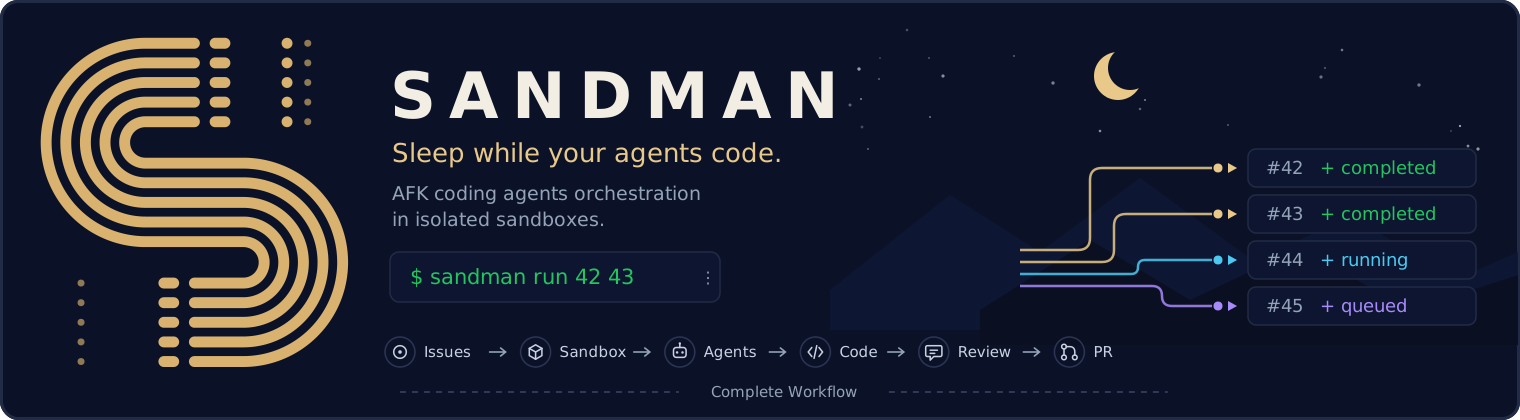
Sandman turns one clear GitHub issue into an autonomous delivery loop. It plans the implementation, runs the agent in an isolated environment, stores progress in task.md, drives review, and merges the PR when the gates pass.
A clear Specification or bug brief produces a well-described GitHub issue. Sandman only needs the work to be precise enough to run.
 SANDMAN
task.mdMerge lands on a reference branch. Run smoke, e2e, and QA before promoting to production, just like fast human work.
Sandman can run while you sleep when the issue has crisp intent, bounded scope, and visible checks.
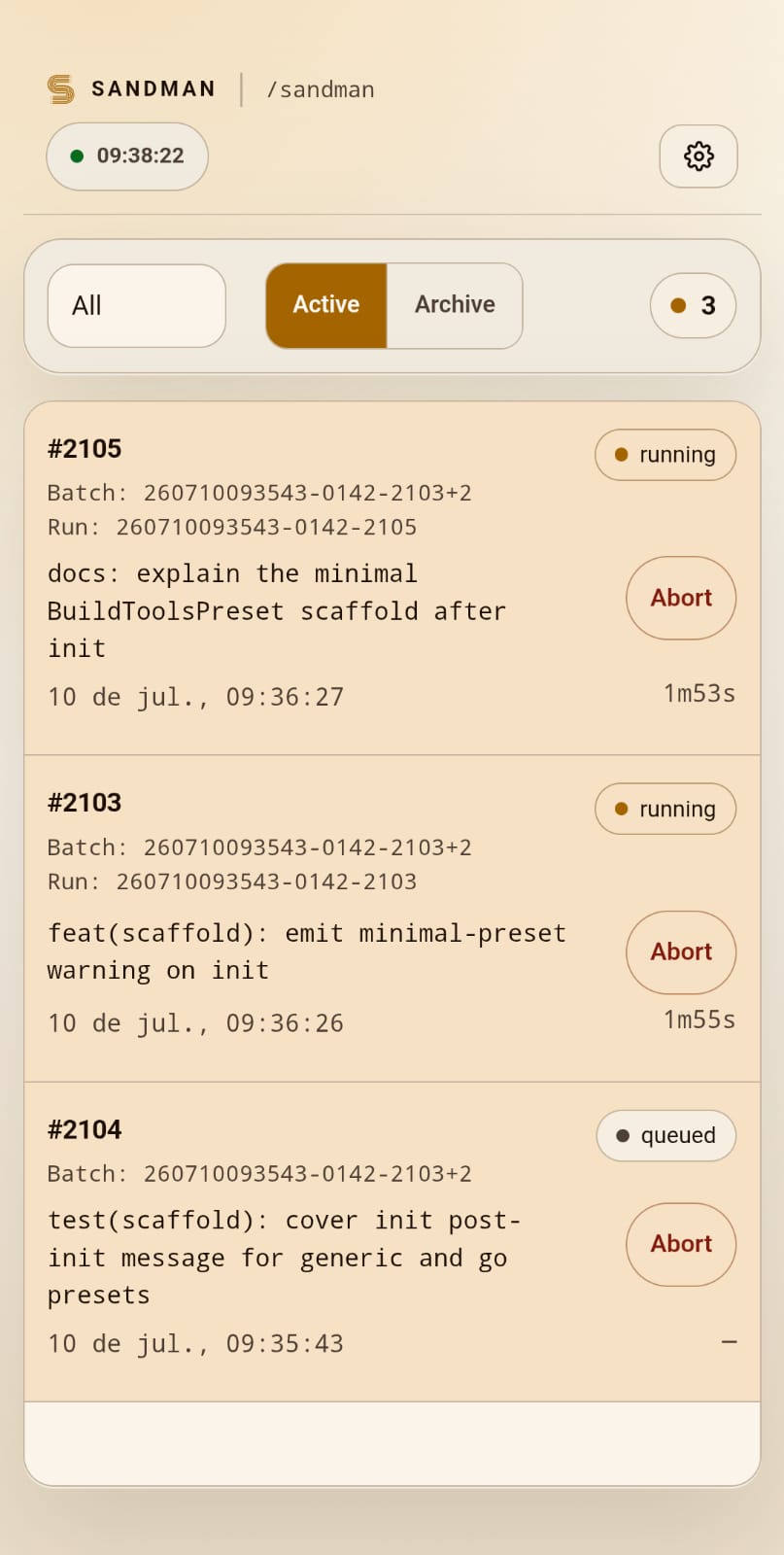
Sandman is a CLI application. Portal is a visualization layer for current runs, queued issues, blockers, review state, logs, and merge readiness.
You do not babysit the agent, but you can inspect the loop at any time.
sandman main ? ❯ sandman run 447 --model opencode/muse-spark-1.2-contributor-free --continue
[260902115556-b36b-447] 11:56:17 → Read /workspace/.sandman/worktrees/447-add-subtractive-extrusion-through-every-adapter/.sandman/task.md
[260902115556-b36b-447] 11:56:20 $ git status; echo "---"; git branch --show-current; echo "---"; git log --oneline -10; echo "---"; git log origin/main...
[260902115556-b36b-447] 11:56:22 $ git diff origin/main --stat; echo "---"; gh pr view --json number,title,state,url,headRefOid,baseRefName,mergeable,re...
[260902115556-b36b-447] 11:56:40 $ gh pr list --head 447-add-subtractive-extrusion-through-every-adapter --json number,title,state,url 2>&1; echo "---";...
[260902115556-b36b-447] 11:56:42 → Read /workspace/.sandman/worktrees/447-add-subtractive-extrusion-through-every-adapter/AGENTS.md
[260902115556-b36b-447] 11:56:43 $ cat docs/agents/issue-tracker.md 2>&1 | head -n 100; echo "---"; cat docs/agents/domain.md 2>&1 | head -n 100
[260902115556-b36b-447] 11:56:45 → Read /workspace/.sandman/worktrees/447-add-subtractive-extrusion-through-every-adapter/CONTEXT.md
[260902115556-b36b-447] 11:56:46 $ git diff origin/main -- crates/host/src/lib.rs | head -n 300
[260902115556-b36b-447] 11:56:51 $ git diff origin/main -- crates/protocol/src/schema.rs crates/protocol/src/schema_validator.rs crates/persistence/src/...
[260902115556-b36b-447] 11:56:53 → Skill "sandman"
[260902115556-b36b-447] 11:56:55 → Skill "sandman-implement"
[260902115556-b36b-447] 11:56:56 → Skill "sandman-code-review"
[260902115556-b36b-447] 11:56:58 $ git diff origin/main...HEAD --stat; echo "==LOGS=="; git log --oneline origin/main..HEAD
[260902115556-b36b-447] 11:57:00 $ git diff origin/main...HEAD | head -n 200
[260902115556-b36b-447] 11:57:04 → Skill "sandman-back-merge"
[260902115556-b36b-447] 11:57:09 $ git status --short; echo "---"; git fetch origin 2>&1 | head -n 20; echo "---fetch done"; git merge-base --is-ancesto...
[260902115556-b36b-447] 11:58:10 $ cargo fmt --check 2>&1 | head -n 50; echo "fmt check exit $?"; echo "---"; cargo test --quiet --workspace 2>&1 | tail...
[260902115556-b36b-447] 11:58:45 $ cargo test --quiet 2>&1 | tail -n 30; echo "exit:$?"
[260902115556-b36b-447] 11:58:53 $ git push -u origin 447-add-subtractive-extrusion-through-every-adapter 2>&1
[260902115556-b36b-447] 11:58:55 $ git log --oneline -1 --format="%s"; echo "---"; git log --oneline origin/main..HEAD --format="%s"
Rendered task, progress notes, and the continuation point for sandman run 1234 --continue.
Agent output, targeted checks, repair loops, and review responses.
Code diff, review thread, green CI, merge decision, and linked issue.
Treat agent output the way you treat fast human output: the loop can merge to a reference branch, but release confidence comes from recurring validation across changes.
TDD is not an AI novelty. It is a traditional control that helps agents work in smaller, safer loops. Keep it, then add broader validation where risk demands it.
The reference branch Sandman merges into should be a branch you can validate, not a direct production promotion.
Today Sandman integrates with GitHub for source control and issues, and supports OpenCode plus Claude Code (experimental in v1) as implementation agents. That boundary may broaden over time, but the durable idea is the same: workflow-agnostic AFK delivery.
The recommended path resolves uncertainty before Sandman takes over the autonomous delivery loop.
wayfinder->to-spec->to-tickets->Sandman->Validation
Use the skills to resolve uncertainty, publish the Specification, and slice clear GitHub issues. Sandman runs the ready issue frontier AFK. This is recommended, not required: Sandman can start from any sufficiently clear GitHub issue.
Sandman uses OpenCode as implementation agent.
Sandman live-mounts the host OpenCode database, so runs created by Sandman remain visible as native OpenCode sessions.
Use Portal for delivery state: run status, logs, review gates, and merge readiness. Use OpenCode for the agent transcript when you need to inspect what the model saw or did.
Sandman Review is the local review module for PR feedback. It follows the same idea as OpenCode's GitHub /oc integration: a PR comment triggers agent work. In Sandman, the trigger is /sandman review and the review runs locally.
Sandman Review listens for review request comments in repository PRs, reviews it, and posts feedback requesting changes or approving.
The implementation agent builds and self-reviews first. Sandman Review then handles feedback, repair, green checks, and merge readiness as part of the gate.
Sandman makes AFK coding operational: explicit input, isolated environment, durable progress, review gates, merge discipline, and a clear post-merge validation step.